
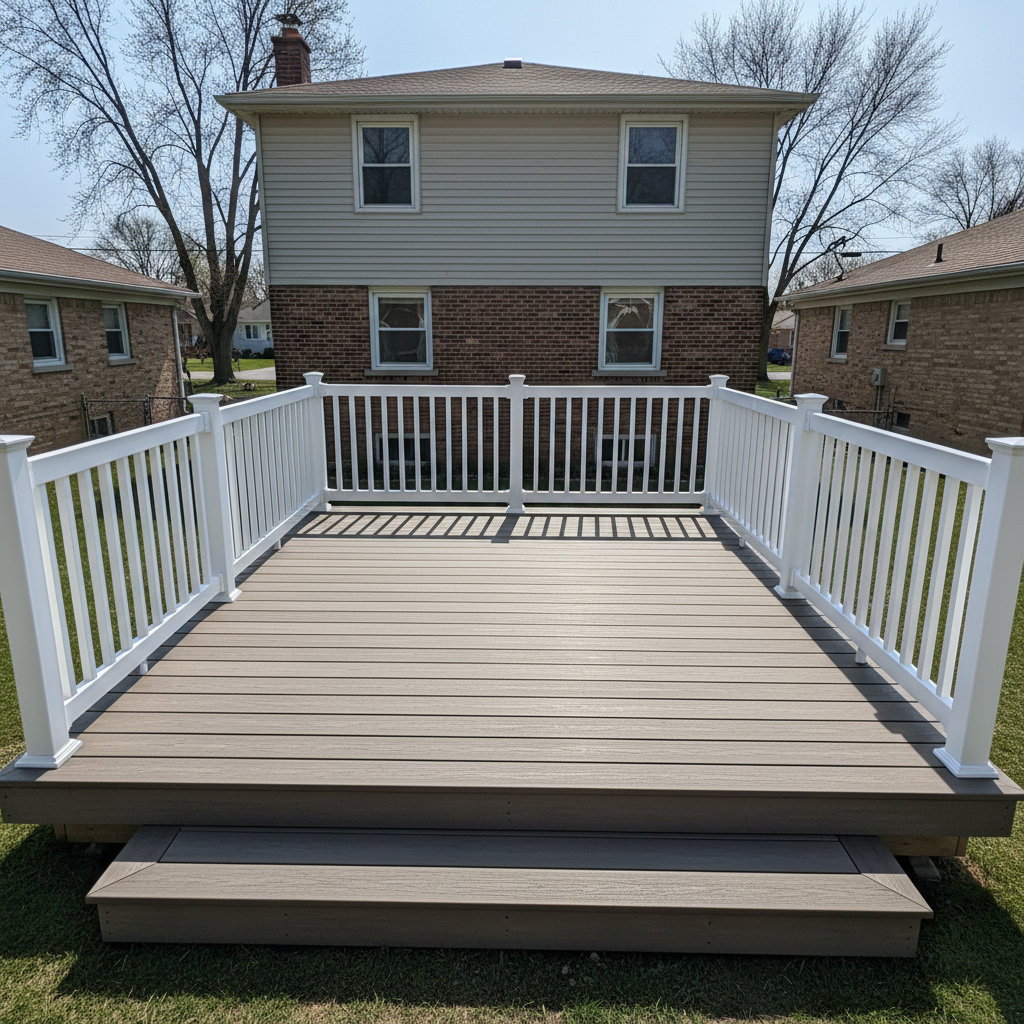
Most people picking a deck builder compare three bids and go with whoever's in the middle. That's not a terrible instinct, but price alone won't tell you who's going to pour a footing deep enough to survive a Kane County winter and who's going to set a post on a bag of Sakrete and hope for the best. Here's what actually matters.
Ask how deep they're going on footings
Northern Illinois has a frost line around 42 inches. That's not a suggestion, it's why your footings need to go that deep or your deck will heave out of the ground over a few winters as the soil freezes and thaws underneath it. Elgin sits on a lot of heavy clay, especially on the older lots near downtown and around the Fox River, and clay holds water and moves more than sandy soil does. A builder who pours a 12-inch footing because it's faster isn't saving you money, they're setting you up for a deck that's visibly tilted by year three. Ask the bidder straight out: how deep are the footings, and are they below frost line. If they hesitate, that's your answer.
What the soil does out here
Clay expands when it's wet and shrinks when it's dry, so a footing that's not poured deep and wide enough can get pushed around seasonally even without freezing. Good builders use a bell-shaped footing or a wider base at the bottom specifically to resist that upward frost push. It costs more concrete and more labor. It's also the difference between a deck that's still square in ten years and one that needs releveling in five.
Permits aren't optional, and skipping them costs you later
In Elgin, most deck work over a certain size or height needs a permit through the city's building department, and if you're just outside city limits it may fall under Kane County instead. Either way, a legitimate contractor pulls the permit, schedules the footing inspection before they pour concrete, and schedules a final inspection once the structure's up. If a builder tells you permits are a waste of time or that they can "keep it under the radar," walk away. Unpermitted decks show up on home inspections when you sell, and some buyers' lenders won't close until it's fixed or torn out. It also means nobody with a trained eye checked your ledger board attachment or your post spacing before it got covered up with decking boards.
Check the ledger board attachment, not just the pretty wood
The ledger board, the piece bolted to your house that the whole deck hangs off of, is where most deck failures start. It needs to be lag-bolted or through-bolted into the rim joist or framing, not nailed, and it needs flashing behind it so water doesn't get trapped against your house band and rot it out from behind. This is the part nobody checks after the fact because it's hidden, which is exactly why you need to ask about it before work starts, not after.
What to ask about materials
- Pressure-treated pine is still the most common frame material here, and it should be rated for ground contact if any part touches soil.
- Joists at 16 inches on center is standard for most decking, but composite boards often call for 12 inches on center to avoid sagging between joists over time. Ask which one they're planning and why.
- Stainless or hot-dip galvanized fasteners matter more than people think. Elgin gets humid summers and plenty of freeze-thaw cycles through the winter, and cheap coated screws corrode and streak the decking within a couple of seasons.
- If composite decking is part of the plan, ask about hidden fastener systems versus face-screwing. Hidden systems look better and cost more labor to install correctly.
Red flags worth walking away from
A bid that's dramatically lower than the others usually means something's getting skipped, often the footing depth or the flashing, and you won't know until it fails. A contractor who won't give you a written contract with a payment schedule is a problem. So is one who wants the whole balance paid upfront before any lumber shows up on site. Ask for proof of insurance, not just a license number. A deck collapse or a fall during construction without insurance behind it becomes your financial problem, not theirs.
Also ask what happens if they hit something unexpected, because they often do. Elgin's older neighborhoods, especially around the historic district, sometimes have shallow utility lines or old concrete footings from a prior structure buried where nobody expects them. A good builder calls JULIE (the state's utility locate service) before digging and has a plan for what happens if the dig turns up a surprise. A builder who's never heard of calling in a locate before digging footings shouldn't be digging footings in your yard.
Newer subdivision or older lot, the approach changes
If you're in one of the newer developments out toward Bartlett or South Elgin, your lot was probably graded flat with decent drainage already built in, and the ground under your deck is more likely to be consistent fill. Older lots closer to downtown Elgin can have uneven grading, mature trees with root systems to work around, and drainage that was never great to begin with. A builder who's worked both kinds of lots locally will know to check which situation you're actually in before quoting a price, instead of giving you a flat number over the phone sight unseen.
Get a few bids, but spend more time listening to how each builder answers the footing and permit questions than comparing the bottom-line number. That's where you find out who's actually done this work in this soil and this climate, not just somewhere warmer and drier where none of it mattered as much. If you want to talk through what your yard and your house actually need, Forge Deck Builders is happy to walk the site with you before you commit to anything.